How to Manage Shop Inventory Using Billing Software: Complete Stock Control Guide
Learn how to manage retail shop inventory using billing software. Master stock inwarding, real-time counter deductions, low-stock alerts, and periodic stock audits.

For any physical retail business—whether a Kirana store, supermarket, garment shop, or hardware mart—inventory represents your largest capital investment. Every rupee sitting on your store shelves is working capital.
Yet, many Indian retailers manage stock through intuition and guesswork. They order goods when shelves look empty, fail to notice slow-moving dead stock gathering dust, and lose thousands of rupees every month to stock shrinkage, untracked theft, or unrecorded customer returns.
Connecting your inventory management directly to your billing software creates a closed-loop stock control system. Every item entering your store is recorded, and every sale automatically updates your stock records in real time.
This comprehensive guide explains how to manage shop inventory using billing software, outlines best practices for stock tracking, and shows how automated tools prevent costly stockouts.
Direct Answer: How to Manage Shop Inventory Using Billing Software
To manage shop inventory using billing software, implement a 5-step closed-loop operational workflow:
- Catalog Setup: Create unique SKU records for every product with descriptions, barcodes, cost prices, selling prices, and HSN codes.
- Purchase Inwarding: Whenever new stock arrives from distributors, enter the purchase invoice into the software to automatically increase stock counts.
- Automated Counter Deduction: Every time an item is scanned and billed at the checkout counter, the software automatically deducts the exact quantity from available inventory.
- Low-Stock Alerting: Set minimum safety stock thresholds for critical products; the software alerts you before items run out completely.
- Periodic Stock Auditing: Compare physical shelf counts against software inventory reports monthly to identify shrinkage, damage, and discrepancies immediately.
With an offline desktop billing tool like VedBill, this inventory cycle operates seamlessly without requiring manual bookkeeping or internet connectivity.
Why Manual Stock Management Fails Retailers
Relying on physical notebook registers or separate spreadsheets creates severe operational blind spots:
- Stockouts During Peak Hours: Running out of high-demand items on a busy weekend directly sends frustrated customers to your competitors.
- Accumulation of Dead Stock: Capital gets locked up in slow-moving merchandise that eventually expires or goes out of fashion without the owner realizing it.
- Undetected Inventory Shrinkage: Without real-time stock balances, shop owners cannot distinguish between legitimate sales, inventory damage, supplier short-shipments, or internal counter theft.
- Inaccurate Reordering: Guessing reorder quantities often leads to over-purchasing slow items while under-purchasing fast-moving everyday goods.
The Closed-Loop Inventory Lifecycle in Modern POS Systems
Effective retail stock control relies on an integrated, four-phase operational cycle:
[Supplier Purchase Inward] ──> [Real-Time Shelf Stock]
                                       │
                                       ▼
[Low Stock Alert / Reorder] <── [Counter Bill Deduction]
Phase 1: Product Master and Barcode Mapping
Every item in your store must have a distinct product identity. Modern billing software allows you to map existing manufacturer EAN barcodes or generate internal barcode codes for unbranded, loose, or repackaged items.
Phase 2: Purchase Entry and Cost Tracking
When a wholesale distributor delivers inventory, enter the supplier's purchase bill into the software. The system updates available stock quantities and updates your purchase cost records, helping you track profit margins accurately.
Phase 3: Instant Counter Stock Deduction
The moment your cashier scans a barcode and completes a transaction, the inventory counter decrements locally. There is no manual bookkeeping or evening data entry required.
Phase 4: Automated Safety Stock Warnings
Define a minimum threshold (e.g., 5 units) for critical items. When stock falls to or below this level, the software automatically displays a reorder warning, generating an instant purchase requisition list.
5 Practical Best Practices for Retail Inventory Management
To achieve complete control over your shop inventory, implement these proven operational habits:
1. Maintain Strict Barcode Discipline
Never allow items to be sold without a barcode scan or item code entry. When cashiers enter generic amounts (such as "Misc Items: ₹100"), stock counts become inaccurate, breaking the entire inventory tracking cycle.
2. Record Damaged, Returned, and Expired Stock Promptly
If a customer returns a product, or if an item is damaged during handling, record it immediately using the software's return or stock adjustment feature. Leaving damaged items unaccounted for skews stock accuracy.
3. Classify Products Using the ABC Analysis Method
Not all inventory items carry equal value. Divide your catalog into three strategic tiers:
- Category A (High Value, Fast Turnover): Fast-moving staples representing 70% of sales. Monitor these daily.
- Category B (Moderate Turnover): Regular items with steady demand. Review weekly.
- Category C (Low Turnover / Specialty): Slow-moving specialty products. Keep lean stock levels to avoid locking up working capital.
4. Conduct Rolling Spot-Checks Instead of Painful Annual Audits
Rather than shutting down your store for three days once a year to count all items, conduct weekly rolling audits. Count one specific shelf or category every Monday morning and reconcile physical stock with the software report.
5. Monitor Gross Profit Margins by Product Category
Billing software tracks both cost price and selling price. Review monthly profit margin reports to identify which product categories generate the highest actual returns versus which items deliver slim margins despite high volume.
Inventory Management Checklist for Shop Owners
Use this operational checklist to evaluate your store's inventory practices:
- [ ] Does every product on your shelves have an active barcode or unique SKU code?
- [ ] Are purchase invoices entered into the system on the day goods are delivered?
- [ ] Does your billing software deduct stock counts automatically upon bill finalization?
- [ ] Have you configured minimum safety stock alert levels for your top 50 selling items?
- [ ] Are customer returns and damaged items recorded through system stock adjustments?
- [ ] Do you generate monthly inventory valuation reports for financial planning?
Comparison: Billing Software Stock Control vs Manual Spreadsheets
| Operational Area | Billing Software Inventory (VedBill) | Manual Excel Spreadsheets / Books | | :--- | :--- | :--- | | Deduction Timing | Instantaneous upon every bill print | Manual entry at end of day or week | | Error Rate | Near zero (<0.1%) with barcode scanning | High (>10%) due to manual typing errors | | Low-Stock Visibility | Automated alerts before items run out | Discovered only after shelves sit empty | | Profit Margin Tracking | Automatic calculation per item and bill | Requires complex manual formulas | | Counter Labor Needed | Zero extra effort during billing | Hours of tedious manual bookkeeping | | Theft/Shrinkage Detection| Immediate discrepancy detection | Discrepancies hidden for months |
The VedBill Solution: Integrated Stock Control for Indian Shops
VedBill combines fast counter billing with comprehensive inventory management, engineered specifically for Indian retail operations:
- Real-Time Stock Updates: Every transaction instantly deducts inventory locally on your PC hard drive.
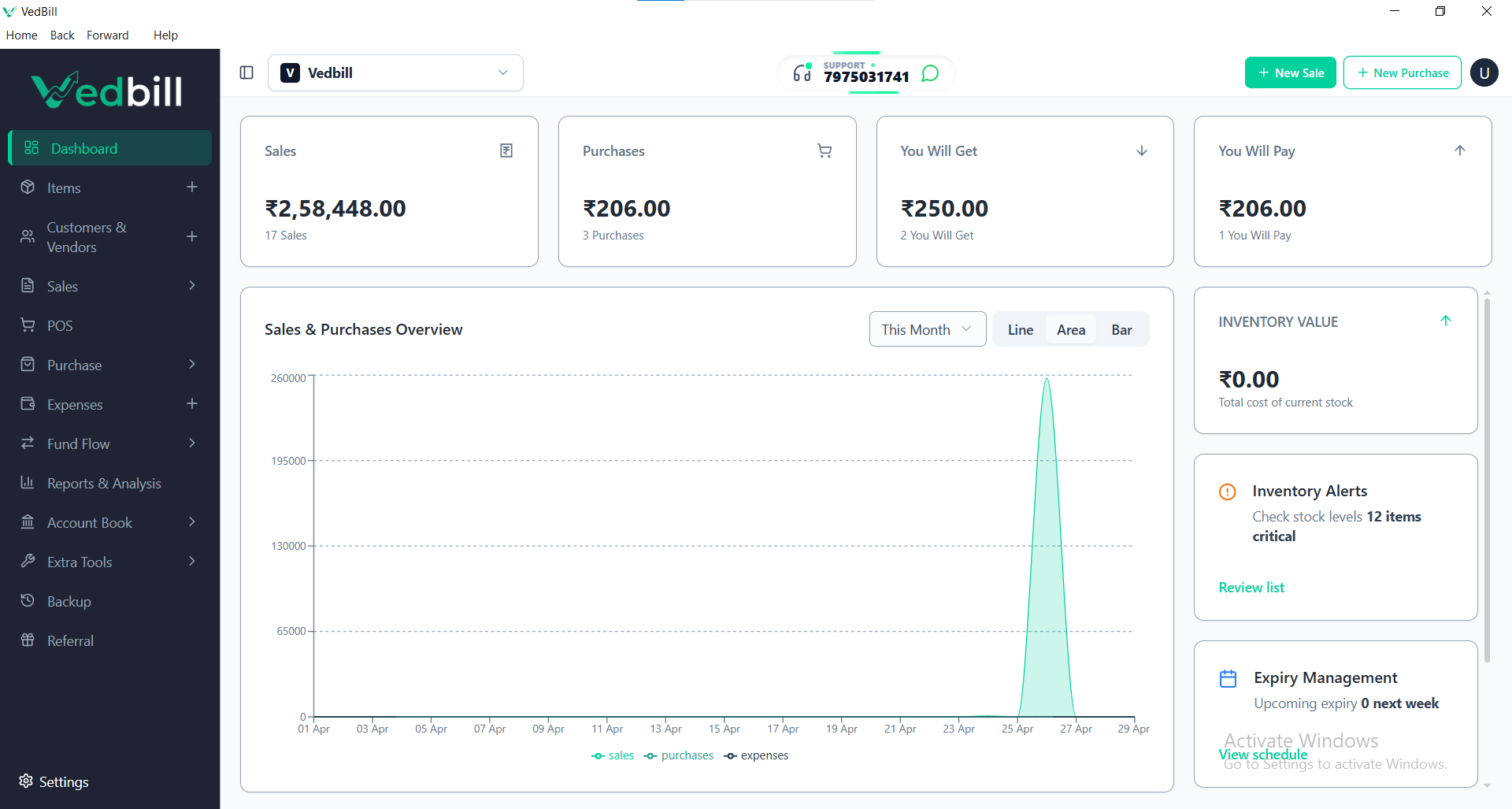
- Automated Low-Stock Alerts: Built-in dashboard warnings flag products approaching reorder levels before stockouts occur.
- Bulk Excel Import & Export: Add thousands of products, opening balances, and prices in minutes using simple spreadsheet templates.
- Batch and Expiry Tracking: Monitor perishable goods and pharmaceutical expiration dates to minimize unsellable waste.
- 100% Free & Offline: Manage your complete inventory without paying monthly software fees or depending on continuous internet connectivity.
Frequently Asked Questions (FAQs)
1. Can I manage stock for loose grocery items like rice, sugar, or pulses?
Yes. VedBill supports decimal quantities and fractional units of measurement (e.g., 0.5 kg, 1.25 kg) as well as package units, allowing accurate inventory tracking for loose and repackaged goods.
2. What should I do when my physical shelf stock doesn't match the software count?
VedBill features an easy "Stock Adjustment" module. You can record differences resulting from accidental breakage, supplier shortfalls, or shrinkage with explanatory notes to re-align software balances with physical counts.
3. How do I know how much total capital is invested in my store inventory?
Within the Reports section of VedBill, generate an "Inventory Valuation Report". The software instantly calculates the total monetary value of your in-stock merchandise based on your purchase cost prices.
4. Can I add new inventory items while customers are waiting at the billing counter?
Yes. VedBill allows cashiers with administrative permissions to add new products directly from the billing screen with quick keyboard shortcuts, eliminating counter bottlenecks when uncatalogued items arrive at checkout.
Conclusion & Next Steps
Effective inventory control is the cornerstone of retail profitability. By letting your billing software track stock movements automatically with every transaction, you eliminate manual bookkeeping, prevent revenue-draining stockouts, and keep your working capital focused on high-demand merchandise.
Take complete control of your shop inventory today.
Download VedBill Free for Windows Desktop and transform your stock tracking with fast, integrated retail billing.
Manage Your Store with VedBill Desktop Software
VedBill is 100% free desktop billing software built for retail shops, supermarkets, pharmacies, and small businesses in India. No recurring subscriptions or expensive cloud fees.
VedBill Editorial Team
Retail & Billing Specialist at VedBill