How to Choose the Right Billing Software for Your Shop: Complete Buyer's Guide
Learn how to choose the right billing software for your retail shop. Evaluate checkout speed, offline stability, hardware support, GST compliance, and total software costs.

Selecting a billing system is one of the most critical operational decisions a retail shop owner will make. The software you install at your checkout counter touches every single customer interaction, manages your physical inventory, tracks daily cash flow, and governs your tax compliance.
Choose the wrong software, and your business will suffer from sluggish counter queues, constant software crashes during internet outages, staff frustration, and expensive subscription traps. Choose the right software, and your counter operations become effortless, accurate, and rapid.
This definitive buyer's guide provides a structured 7-step framework to help Indian shopkeepers choose the perfect billing software for their store.
Direct Answer: How to Choose the Right Billing Software for Your Shop
To choose the right billing software for your shop, evaluate five essential operational pillars:
- 100% Offline Stability: The software must function continuously on your local computer hard drive without requiring active internet connectivity.
- Checkout Counter Speed: Item lookup, barcode scanning, and receipt printing must execute in under two seconds per transaction.
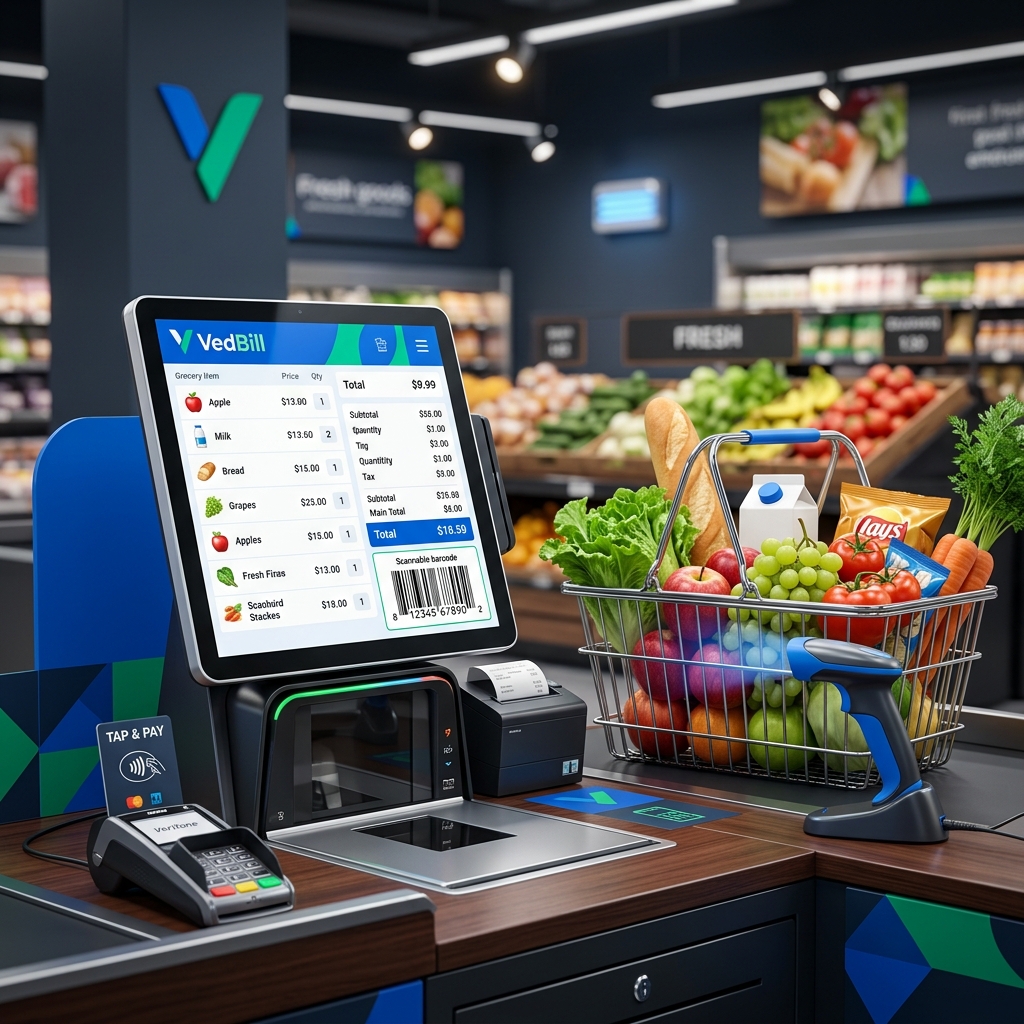
- Hardware Compatibility: The system must connect seamlessly via USB with your barcode scanner, thermal receipt printer (58mm/80mm), and cash drawer.
- Automated GST Compliance: It must calculate CGST, SGST, and IGST automatically, format HSN codes correctly, and export GSTR sales summaries to Excel.
- Zero Recurring Overhead: Choose software with zero monthly subscription fees to avoid draining operational profits.
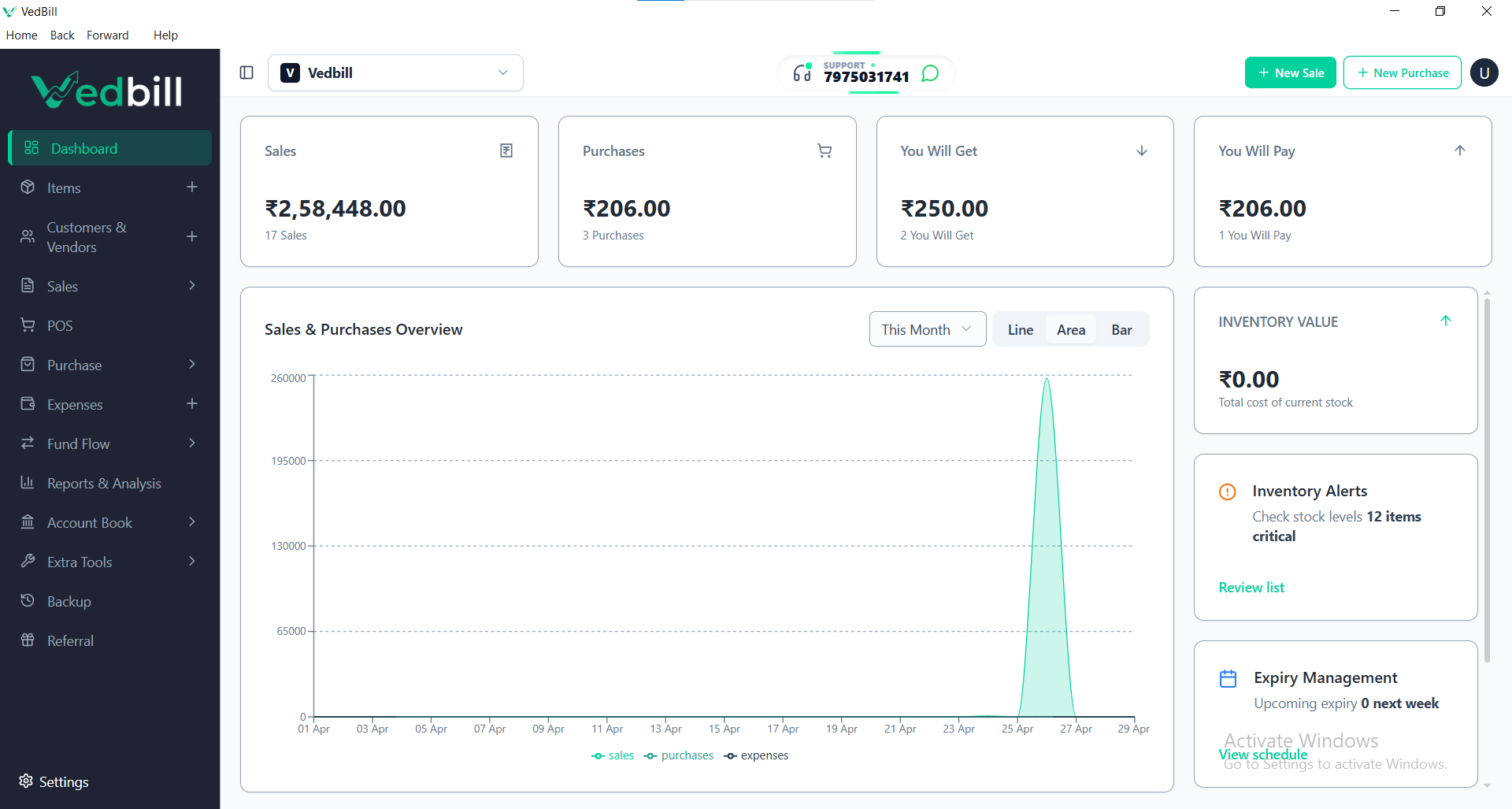
For most Indian retail shops, VedBill meets all five criteria by offering a high-speed, 100% offline Windows desktop billing platform completely free of charge.
The 7-Step Evaluation Framework for Shop Owners
Follow this step-by-step checklist when reviewing any billing software:
Step 1: Determine Your Store's Daily Foot Traffic and Speed Requirements
If your store processes dozens of walk-in customers during concentrated peak hours (such as Kirana stores, grocery marts, bakeries, or apparel shops), software speed is paramount. Avoid cloud-only web applications that require constant page refreshes or display loading spinners between scans. Choose local desktop applications that respond instantaneously.
Step 2: Verify 100% Offline Independence
Ask software providers directly: "What happens when my internet cable is disconnected or my broadband router fails?" If the software cannot create a new bill, look up prices, or print receipts during an internet drop, it is unfit for retail counter operations in India.
Step 3: Check Hardware Plug-and-Play Compatibility
Ensure the software interfaces easily with standard point-of-sale peripherals without requiring expensive proprietary hardware:
- Standard 1D and 2D handheld USB barcode scanners.
- Thermal receipt printers (58mm 2-inch and 80mm 3-inch models like EPSON, TVS, NGX, Everycom).
- Standard office laser or inkjet printers for full-page A4/A5 tax invoices.
- Electronic cash drawers connected via RJ11 printer ports.
Step 4: Examine Indian GST and Tax Reporting Features
Your software must handle Indian tax legislation effortlessly:
- Pre-set tax slabs: 0%, 5%, 12%, 18%, and 28%.
- Automatic tax splitting: CGST + SGST for local sales, IGST for interstate customers.
- Separate support for B2C consumer cash memos and B2B registered tax invoices with customer GSTIN.
- One-click monthly GSTR-1 and GSTR-3B export directly into Excel format for your chartered accountant.
Step 5: Test Counter Staff Usability and Keyboard Shortcuts
In many Indian retail stores, counter operators and shop assistants have basic computer literacy. The software interface must be clean, uncluttered, and navigable entirely via keyboard shortcuts (such as pressing F1 for new bill, Enter to finalize, Esc to clear). If staff training takes more than 30 minutes, the software is unnecessarily complex.
Step 6: Evaluate Real-Time Stock and Inventory Tracking
Billing software should not just print paper slips; it must maintain strict stock control. Ensure the software:
- Automatically reduces stock counts immediately when a bill is generated.
- Warns counter staff if an item is out of stock.
- Provides low-stock alert thresholds for automatic reordering.
- Supports batch numbers and expiry date tracking (essential for grocery and pharmacies).
Step 7: Calculate Total 3-Year Software Costs
Carefully calculate the total financial commitment across three full years. Beware of low monthly introductory offers that escalate into hefty annual renewals. Prioritize genuine free software or transparent one-time licenses over open-ended recurring subscriptions.
Sector-Specific Requirements: What Does Your Shop Need?
Different retail sectors have specialized counter requirements:
| Retail Business Type | Critical Software Features Needed | | :--- | :--- | | Kirana & Grocery Marts | Rapid barcode scanning, loose item weight entry, thermal receipts with UPI QR code | | Apparel & Garment Stores | Size/Color variant management, barcode sticker generation, exchange handling | | Pharmacies & Medical Stores| Batch number tracking, product expiry date alerts, physician name recording | | Hardware & Electrical Stores| Dual retail/wholesale pricing, multi-unit conversions (meters, pieces, boxes) | | Wholesale Distributors | B2B tax invoicing, credit ledger (Credit Ledger) tracking, vehicle & transport fields |
5 Critical Mistakes to Avoid When Choosing Billing Software
- Buying Complicated Enterprise ERPs: Purchasing industrial accounting suites with hundreds of confusing ledger options overwhelms counter staff and creates long customer queues.
- Falling for "Freemium" Watermark Scams: Using software that prints vendor advertisements across your customer receipts undermines your store's credibility.
- Ignoring Data Backup Procedures: Failing to verify how the software creates database backups leaves you vulnerable if your computer hard drive fails.
- Purchasing Locked Proprietary Hardware: Choosing POS platforms that force you to buy expensive proprietary touchscreens or locked printers prevents easy hardware replacement.
- Skipping Keyboard-Only Testing: Selecting software that forces counter staff to click buttons with a mouse for every single action severely slows down checkout speed.
10-Point Decision Checklist for Retailers
Before finalizing your choice, test the software against this rapid checklist:
- [ ] Does it operate 100% offline without requiring internet?
- [ ] Can a bill with 5 items be completed and printed in under 10 seconds?
- [ ] Can all essential billing actions be performed using keyboard shortcuts?
- [ ] Does it automatically calculate CGST, SGST, and IGST based on customer location?
- [ ] Does it print cleanly on standard 58mm and 80mm thermal receipt printers?
- [ ] Does it generate scannable UPI QR codes on receipts for quick digital payment?
- [ ] Does it deduct inventory in real time and alert on low stock levels?
- [ ] Can you export complete sales records to Excel for monthly GST filings?
- [ ] Can you back up your database to a USB pendrive in one click?
- [ ] Is the software completely free of ongoing monthly subscription renewals?
The VedBill Solution: Built for Indian Shop Counters
VedBill was engineered specifically to meet the real-world operational demands of Indian retail store owners:
- 100% Free Forever: Zero subscription fees, zero license renewals, and no invoice limits.
- Lightning-Fast Offline Speed: Built natively for Windows 10 and 11, processing transactions instantaneously.
- Comprehensive Hardware Support: Plug-and-play compatibility with all standard USB barcode scanners, thermal receipt printers, and desktop laser printers.
- Effortless GST Compliance: Pre-configured tax calculations, HSN code management, and one-click GSTR Excel exports.
- Simple Keyboard Navigation: Intuitive interface that anyone can master in under fifteen minutes.
Frequently Asked Questions (FAQs)
1. Can I try billing software before installing it across my store?
Yes. You can install VedBill on any Windows laptop or desktop computer, load a few sample products, connect your thermal printer, and test complete billing workflows in minutes without financial commitment.
2. Can I import my existing product list from an Excel spreadsheet?
Yes. VedBill provides an easy bulk Excel import feature that lets you upload your entire catalog—including product names, barcodes, MRP, cost prices, tax rates, and opening stock—in a single step.
3. What computer hardware is required to run modern billing software?
VedBill is lightweight and runs smoothly on any standard Windows PC or laptop running Windows 10 or Windows 11 with at least 4GB of RAM and basic processor configurations.
4. How long does it take to train new retail staff on VedBill?
Because VedBill features a clean layout and streamlined keyboard shortcuts, new counter staff can learn to create bills, scan items, and print receipts within 15 to 20 minutes.
Conclusion & Next Steps
Choosing the right billing software is an investment in the daily efficiency, customer satisfaction, and financial accuracy of your retail store. By prioritizing offline reliability, high checkout speed, standard hardware compatibility, and zero subscription costs, you set your business up for sustained success.
Make the smart choice for your retail counter.
Download VedBill Free for Windows Desktop today and experience fast, dependable point-of-sale billing built for Indian shops.
Manage Your Store with VedBill Desktop Software
VedBill is 100% free desktop billing software built for retail shops, supermarkets, pharmacies, and small businesses in India. No recurring subscriptions or expensive cloud fees.
VedBill Editorial Team
Retail & Billing Specialist at VedBill